Age Estimation in KYC: Balancing Accuracy and Privacy

Your customers thrive in the digital world: they’re accustomed to having digital identities that give them lightning-fast access to a wide range of services. So, every extra second of friction may push them away. Yet, every lapse in compliance can cost you millions. It seems like businesses are stuck between a rock and a hard place: one wrong age estimate can mean onboarding a minor or locking out a legitimate customer – and paying a price for both.
As global Know Your Customer (KYC) regulations tighten, businesses are caught in a „privacy paradox”: how do you verify a user’s age with surgical precision without over-collecting sensitive personal data? To win, B2B leaders must move beyond outdated methods and embrace privacy-first age estimation.
In this article, we will analyze how to strike the right balance between accuracy and user anonymity in age estimation for KYC.
What Is Age Estimation and Why Does It Matter in KYC?
Age estimation, often confused with age verification, is about figuring out how old someone is based on observable traits and patterns. And this is no longer just a human judgment call. With general technological advances and machine learning, systems can analyze facial features, skin tones, and other signals to estimate age quickly and with impressive accuracy.
Why does this matter? With over 1.3 billion children worldwide already part of the digital ecosystem, ensuring age-appropriate access has become a critical challenge for online services. Thus, age is a gatekeeper category in KYC.
This means businesses constantly face the challenge of keeping age-restricted services out of minors’ reach. Age confirmation helps ensure that children don’t access services or content that aren’t appropriate for them. So, getting age estimation during the KYC process right not only protects users, especially children, but also reduces legal risk and builds trust.
However, how we do that, and how accurate it is, makes all the difference.
Nearly 40% of children aged 8–12 in the US are already active on social media – platforms they were never supposed to access. Source
Age Estimation vs. Age Verification
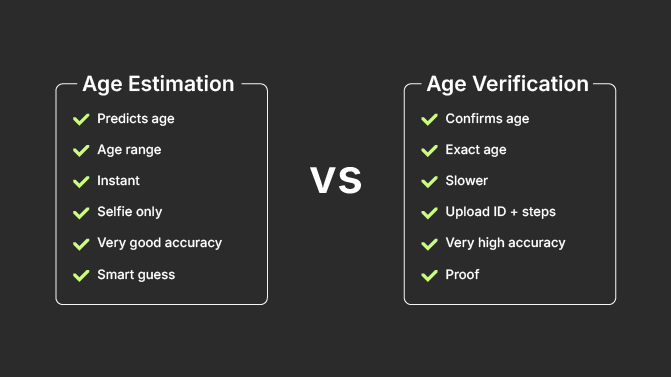
First, let’s clarify the difference between AI-powered age estimation and age verification.
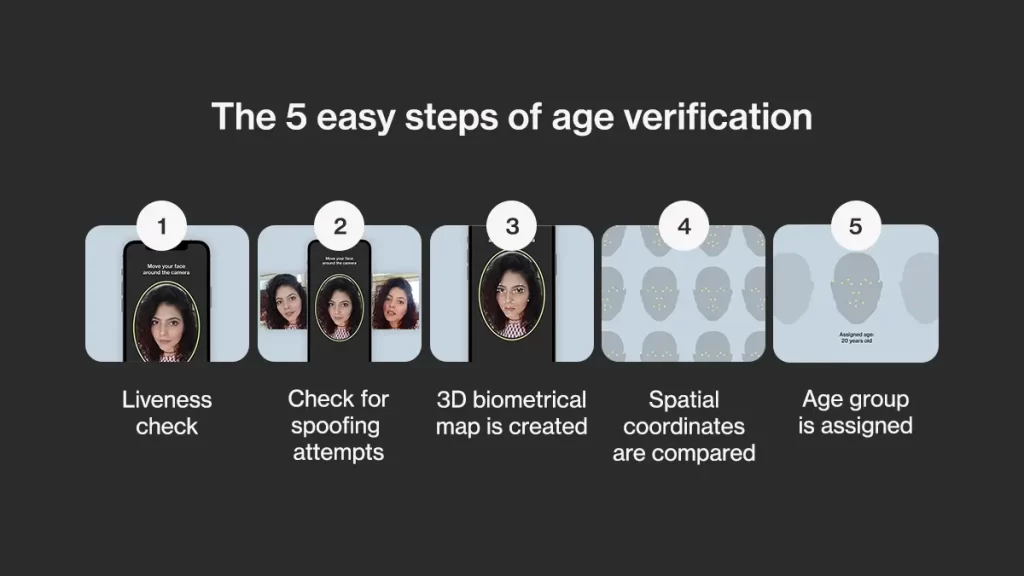
AI-based age estimation uses algorithms to predict a person’s age based on their appearance, most often from a selfie or video. It doesn’t rely on any official data, only patterns learned from large datasets. Here is how facial age estimation works:
- It gives an estimated age or age range; for example, “this person is likely to be 18–22 years old.”
- It’s an instant and frictionless process.
- For the user, the effort is minimal: just a selfie is required.
- It offers high accuracy, but not exact age, as there’s always a margin of error.
- It’s best for quick age checks, low-friction digital onboarding, and age gating.
In other words, facial age estimation is an intelligent, safe, and often quite accurate guess.
Age verification relies on trusted sources of truth, such as government-issued IDs, databases, or verified credentials. Here is how it works:
- It confirms a person’s date of birth and gives you their exact age.
- The main methods include document verification (passport, ID card, driver’s license), database checks (credit bureaus, government records), and digital identity wallets or credentials.
- It’s slower than age estimation.
- For the user, the effort is higher, as they need to share identity documents and take additional steps.
- Its accuracy is very high, making it solid proof of age.
In other words, age verification is an evidence-based confirmation.
Both age estimation and age verification are used together in the KYC process, with estimation usually acting as the first gate (for example, to flag underaged minors), and verification serving as a fallback or an additional compliance step when certainty is required.
In practice, the method and age estimation technology you choose for your business depends on the balance among user experience, risk tolerance, and regulatory requirements.
How does AI-based Age Estimation Work?
AI-based age estimation works by analyzing facial features and matching them to patterns learned from large datasets. By looking at a face, often from a selfie, the system makes an educated guess about how old that person is, usually placing them into an age range rather than giving an exact number.
As we age, our faces naturally change: bone structure shifts slightly, skin loses elasticity, wrinkles appear, and things like hair color and facial fullness can change. For example, a teenager’s smoother skin and facial proportions look very different from someone in their 40s, where fine lines and texture become more visible.
Moreover, certain lifestyle factors, like sun exposure, smoking, stress, or lack of sleep, also play a role, which is why two people of the same age can look quite different. And these patterns can vary across genders as well, which AI models learn to account for.
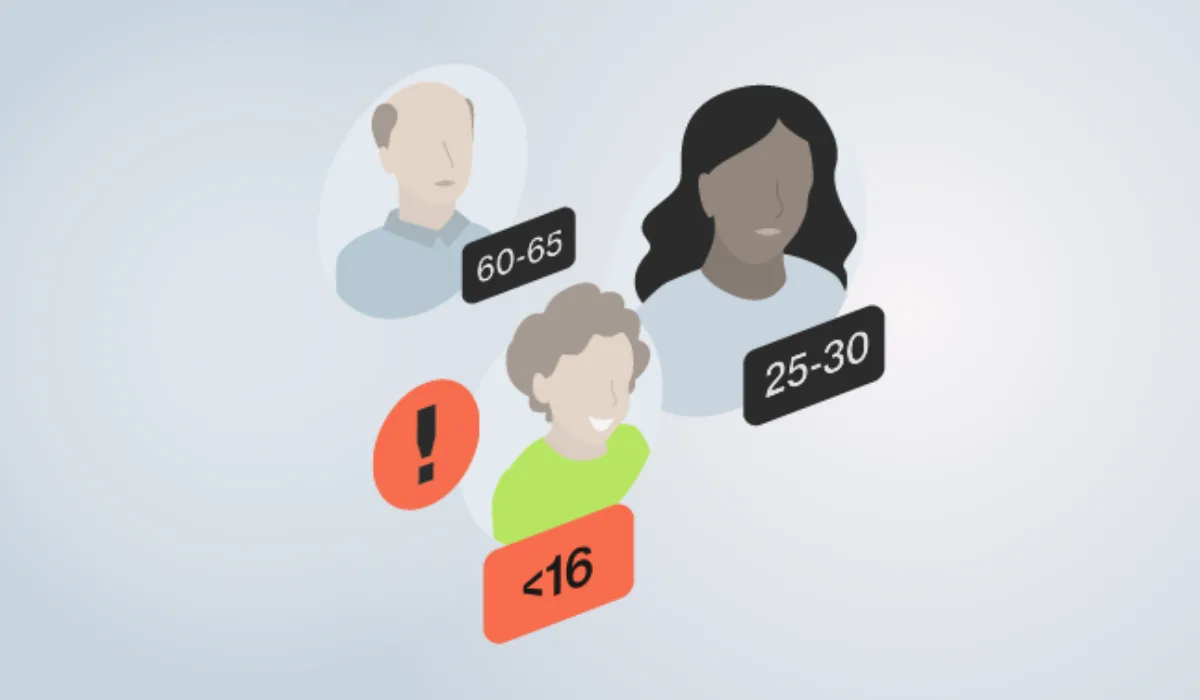
Behind the scenes, machine learning models are trained on millions of labeled facial images. They learn to spot subtle signals like skin texture, facial contours, and other visual cues, then use that knowledge to predict an age range, for example, “this person is likely to be 25–30 years old”. While not exact, modern models are highly accurate and fast, making them well-suited for real-time use cases.
Challenges of Using Age Estimation in Compliance
Age estimation may sound straightforward: figure out how old someone is and move on. But in reality, it’s a lot more nuanced, especially when compliance comes into play. Businesses aren’t just trying to estimate age; they’re trying to meet legal requirements while keeping the user experience smooth. And that’s not an easy task.
In many regions, regulations mandate companies to prevent minors from accessing restricted services in a reliable way. The problem is that even though AI-based age estimation is fast and user-friendly, it doesn’t provide absolute proof of age, but rather gives a strong probability. And regulators don’t always accept “probably over 18” as good enough.
For example, some frameworks (like GDPR) expect companies to apply risk-based, proportionate age assurance methods. And in such businesses as gambling, alcohol sales, or adult content, this often means going beyond estimation and using stronger verification methods, like identity verification.
Let’s take a more detailed look at key challenges of using the age estimation method in KYC:
Accuracy Concerns in Automated Age Estimation
Although not perfect, AI can be impressively good at estimating age. But in compliance, “almost right” can still be a problem.
For example, if someone is 17 but the system estimates them as 19, they might get access to something they legally shouldn’t. On the flip side, a 25-year-old who looks younger could be incorrectly flagged as underage and blocked – and a business may lose a legitimate customer.
Such age estimation inconsistencies happen because people age differently. Lifestyle, genetics, lighting, camera quality, and even makeup can affect how old someone appears. For instance, a teenager using filters or heavy makeup might appear older than they actually are.
Even the best models work with probabilities and ranges, not certainty. That’s why many systems say something like “likely 18–24” instead of a precise age.
And while modern AI models can reach high accuracy rates in controlled conditions, performance can vary across different age groups. This is why regulators often expect companies to test and monitor accuracy across demographics rather than just relying on average performance.
Privacy Considerations and Data Sensitivity
To estimate age, systems often analyze biometric data – a person’s face. Under certain regulations, such as GDPR, this is considered sensitive personal data, which means companies need strong safeguards in place.
From a user’s perspective, this can feel intrusive. Users, after taking a selfie to access a service, may be concerned about where their photo is being stored and for how long. Surveys consistently show high levels of concern around personal data; for example, about 71% of adults say they are concerned about how their data is used, especially when it involves images or biometrics.
That’s why businesses need to be very clear and careful, and:
- Collect only what’s necessary (don’t store images if you don’t need to)
- Be transparent about how data is used
- Ensure strong security and process data in real time without retention
With Ondato’s age verification system, you can get accurate estimates of a client’s age in just a few seconds. We boost 95% accuracy and only require personal documents when there are doubts.
Our solutions can be effectively implemented in a wide variety of businesses required to verify age before providing a service, which includes sites dealing in adult content. For example, you can read more about how one of our clients applies our age estimation solution in this OnlyFans case study.
Final Thoughts
Age estimation plays a crucial role in KYC processes. It ensures compliance with age restrictions for various products and services, from adult content and gambling to alcohol and tobacco industries or even gaming.
Yet, it’s important to understand that age estimation sits at the intersection of accuracy and privacy.
Push too far on accuracy, and you risk collecting more sensitive data than users are comfortable with.
Focus too much on privacy, and accuracy or compliance might suffer. The challenge is finding the right balance for your use case.
FAQ